What to Write in a Funeral Guest Book
A Guide to Meaningful Memorial Messages
At a funeral or memorial service, there is often a quiet table near the entrance with flowers, photographs, a pen, and a guest book waiting to be signed. It seems like such a simple thing—until you're the person standing there with the pen in your hand, trying to figure out what to write.
Should you simply sign your name? Should you write a message to the family? Is it appropriate to share a memory? What if you didn't know the person who passed away very well?
There really isn't one perfect thing to write in a funeral guest book. What matters most is leaving something sincere that helps the family remember not only who attended, but also how their loved one touched the lives of the people around them.
A memorial guest book can become much more than a record of attendance. Families may return to it weeks, months, or even years after the service, making the names, memories, and messages inside a lasting part of how their loved one is remembered.
What Is the Purpose of a Funeral Guest Book?
Traditionally, a funeral guest book provides a record of the people who attended a funeral, visitation, memorial service, or Celebration of Life. That alone can be valuable. During an emotional day, family members may not remember everyone who came to support them.
But today's memorial guest books can do much more.
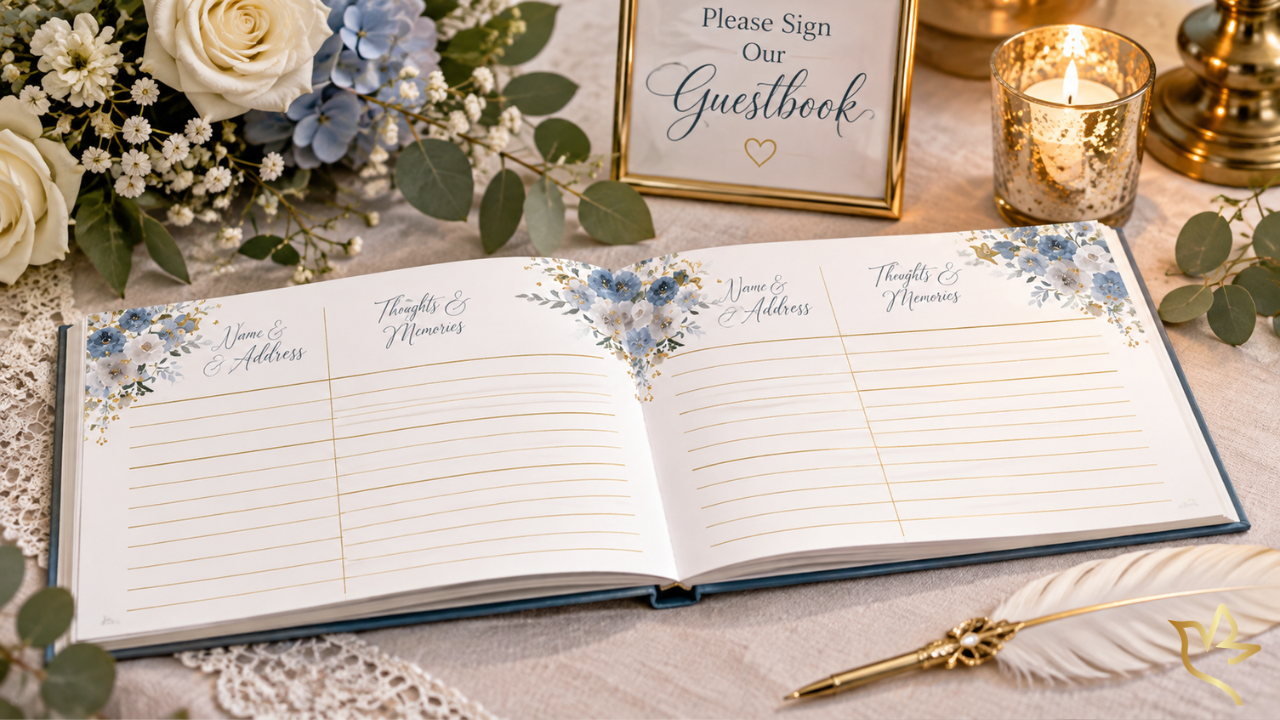
Many include room beside each name for guests to write a memory, a few words about the person who died, or a message of love and support for the family. Those entries can transform an ordinary attendance book into a treasured keepsake.
A name tells the family that you were there.
A memory tells them why their loved one mattered to you.
What Should You Write in a Funeral Guest Book?
You don't need to write something profound. You don't need to find the perfect quotation, and you certainly don't need to fill the entire space.
Start with your name. If the family might not immediately recognize it, add how you knew their loved one—perhaps as a coworker, neighbor, church friend, childhood friend, or former classmate. That small piece of information may become especially valuable years later when the family looks through the book again.
Then, if there is room, add something from your heart.
It might be a brief expression of sympathy, something you admired about the person, a favorite memory, or simply a few words telling the family that you're thinking of them.
Short Funeral Guest Book Messages
Sometimes a few words really are enough, particularly when emotions are high or other guests are waiting to sign.
You might write something like:
Remembering Michael with love and thinking of your family today.
It was a privilege to know Susan. She will be deeply missed.
Sending your family love, comfort, and strength in the days ahead.
I will always remember Robert's wonderful sense of humor and the way he made everyone feel welcome.
With heartfelt sympathy and many wonderful memories of Carol.
The important thing isn't length. It's sincerity.
Share a Memory When You Can
One of the most meaningful things you can leave behind is a memory that the family may never have heard.
Perhaps their father helped you through a difficult first week at a new job.
Maybe their mother brought cookies to every neighborhood gathering.
Perhaps their grandmother had an unforgettable laugh.
Maybe their brother was the person who could make everyone else laugh when things weren't going well.
These little stories can be incredibly precious because families don't get to see every part of their loved one's life.
You might write:
I'll never forget the way David welcomed me on my first day at work. I was nervous and knew absolutely no one, and within five minutes he had me laughing. That was David. He had a wonderful way of making people feel like they belonged.
That kind of message gives the family something more than condolences. It gives them another tiny piece of their loved one's story.
What If You Didn't Know the Person Very Well?
This is one of the situations people commonly worry about, and there is absolutely nothing wrong with keeping your message simple.
Perhaps you're attending because the deceased was your friend's mother. Maybe you're supporting a coworker whose spouse died. You might be a neighbor or acquaintance who didn't know the person closely.
You don't need to pretend otherwise.
You can simply acknowledge your connection and offer support. Current funeral-writing guidance commonly recommends this straightforward approach when the relationship was limited.
For example:
I didn't have the opportunity to know your father well, but I've heard so many wonderful things about him. I'm thinking of you and your family.
Or:
I'm a friend of Jennifer's and wanted your family to know how much we're thinking of all of you today.
Your presence matters, even when you don't have a personal story to share.
Should You Include a Religious Message?
If you know the family's faith and believe a religious message would bring them comfort, it can certainly be appropriate.
You might mention prayer, God's comfort, eternal life, or a meaningful scripture.
If you're uncertain about the family's beliefs, however, a simple expression of love and sympathy is usually the safest choice. Current guest-book guidance similarly recommends avoiding assumptions about another family's religious beliefs.
The goal is to comfort the family—not to make the message about your own beliefs.
What Should You Avoid Writing in a Memorial Guest Book?
A funeral guest book isn't the place to explain why you believe the death happened, discuss family disagreements, tell an embarrassing story, or offer advice about how someone should grieve.
Be particularly careful with phrases intended to make grief disappear.
Even when they're well meant, statements about someone being "better off" or telling a grieving person that they need to "stay strong" may not provide the comfort you intended.
You don't have to solve grief.
You can simply acknowledge the loss and remind the family that their loved one mattered.
Don't Forget to Sign Your Full Name
This sounds obvious, but it can become surprisingly important.
If the person who died knew several people named Susan, John, Mary, or Michael, a first name may not mean much when the family opens the guest book years later.
Write your full name clearly.
If appropriate, add a little context:
Robert Williams — Tom's coworker at the fire department
Angela Martinez — friend from St. Mary's
Susan and Mark Carter — neighbors on Elm Street
That tiny detail can turn an unfamiliar name into a recognizable part of the person's life.
If You're Planning the Funeral, Give Guests Room to Say More
If you're the person choosing the memorial guest book, consider one that provides room for more than a signature.
A simple prompt such as "Thoughts & Memories" can encourage people to leave little stories and messages that might otherwise never be written down.
And don't feel that every guest has to write something.
Some people will leave a beautiful paragraph.
Some will write one sentence.
Some may only be able to sign their name.
All three are okay.
What matters is that the book becomes a record of the people who came together to remember someone who was loved.
A Memorial Guest Book Becomes Part of Their Story
Long after the flowers are gone and the service has ended, a memorial guest book remains.
Someday, a spouse may open it and reread the stories people shared about their husband or wife. A child may discover something about a parent they never knew. A grandchild may recognize the names of people they've heard about their entire life.
That's why the words you leave don't have to be eloquent.
They simply need to be yours.
A name, a memory, a few kind words—sometimes that's enough to preserve one more little piece of a life that mattered.
Create a Memorial Guest Book Filled With Memories
If you're planning a funeral or Celebration of Life, choose a personalized memorial guest book that gives family and friends room to leave their names, thoughts, and favorite memories. Each message becomes another piece of your loved one's story to keep long after the service is over.
Browse our Memorial Guest Book Collection →
You’re welcome to explore our funeral program collections and find the design that feels right for your loved one—created to help you honor their memory with care and ease.
Each template is fully editable in Canva, allowing you to add photos, update text, adjust colors, and personalize every detail—no design experience needed.
If you need additional support during this tender time, our compassionate team is here for you. Please fill out the form below, and let us guide you through creating a beautiful memorial for your loved one. We're with you every step of the way
Your privacy is incredibly important to us. Rest assured, we will always protect your information and never share it with anyone, for any reason. We're committed to keeping your trust