How to Write a Eulogy for My Daughter

A Heartfelt Guide
There are some losses for which language feels impossibly small.
Losing a daughter can be one of them.
Whether your daughter was a little girl, a teenager, a young woman finding her place in the world, or a woman with children and grandchildren of her own, she was still your daughter. Somewhere inside you may live every version of her at once—the baby you held, the child whose hand fit inside yours, the girl whose personality seemed to grow larger by the day, and the woman she became.
Now you're being asked to stand in front of people who loved her and somehow explain what she meant to you.
How do you do that?
How do you put into a few minutes the first time you saw her face, the sound of her laugh, the things she loved, the person she became, the memories you thought you would have forever, and all the things you still wish you could say?
You don't.
Not all of it.
A eulogy cannot hold an entire life, and it certainly cannot hold everything a parent feels for a daughter.
It doesn't have to.
Your job isn't to explain the size of your loss. You don't have to prove how much you loved her. And you don't have to find words profound enough to make sense of something that may not make sense to you at all.
You simply need to help people remember her.
Her personality.
Her laughter.
The things that delighted her.
The people she loved.
The things she cared about.
The funny little habits that made her unmistakably herself.
The child she was, the person she became, and the love she brought into your life simply by being your daughter.
Those are the pieces from which you can begin.
Why Writing a Eulogy for Your Daughter Feels So Difficult
Parents spend so much of their children's lives looking forward.
You wonder who they will become.
You celebrate milestones and anticipate the next ones. First words become first days of school. Childhood becomes adolescence. Graduation becomes adulthood. Perhaps there are careers, relationships, weddings, children, grandchildren, adventures, and plans for a future you assume you will have the privilege of watching unfold.
Even when your daughter is fully grown, some part of you may still look at her and see every age she has ever been.
That is one reason writing her eulogy can feel so overwhelming.
You aren't remembering one version of her.
You're remembering all of them.
You may look at a photograph of the woman she became and suddenly see the little girl who once climbed into your lap. You may remember the clothes she insisted on wearing, the toy she carried everywhere, the first day of school, the music she loved as a teenager, or the moment you realized she had become an adult with opinions, dreams, strengths, and a life entirely her own.
If she had children, you may have watched her become a mother herself.
If she had a career, passion, talent, or calling, you may have watched her build something that belonged completely to her.
And through every change, she remained your daughter.
When you sit down to write about her, grief may make you feel as though you need to capture every stage because leaving anything out somehow leaves part of her behind.
It doesn't.
The eulogy is not the container for every memory.
Those memories belong to you, to her family and friends, and to all the people whose lives intersected with hers.
Your eulogy is simply one place where some of them can be shared.
Six Simple Steps to Writing a Heartfelt Eulogy for Your Daughter
Trying to begin with the first sentence can make this task much harder than it needs to be.
Instead, begin with your daughter.
Give yourself permission to remember without organizing anything yet. The structure can come later.
Step 1: Remember Her at Different Ages
Start by thinking through the different seasons of your daughter's life.
What was she like as a baby or little girl? What characteristics appeared early and stayed with her?
Maybe she was fearless from the beginning. Perhaps she was gentle, curious, stubborn, imaginative, funny, shy, independent, affectionate, determined, or always asking questions.
Think about school years, teenage years, and adulthood.
What changed?
What never changed?
Look through photographs if that feels comforting. Read cards, letters, messages, or old social media posts. Ask family members what they remember.
You don't have to use all of these memories in the eulogy.
You're simply gathering pieces of her life.
Step 2: Think About What Made Her Unmistakably Herself
Try completing this sentence:
“One of the things that made my daughter completely herself was…”
Perhaps it was her laugh.
Her kindness.
Her determination.
Her sense of humor.
Her love of animals.
Her ability to talk to absolutely anyone.
Her obsession with a particular song, movie, food, hobby, or place.
Maybe she was the person who remembered everyone's birthday. Perhaps she filled a room with energy, or maybe she was quieter and had a way of making one person at a time feel deeply seen.
Don't settle for a generic description if a specific memory can show people what you mean.
Instead of simply saying she was compassionate, tell them what she did when she saw someone hurting.
Instead of saying she loved her family, tell them how she showed it.
Let the people listening recognize her.
Step 3: Choose a Few Stories That Bring Her to Life
A meaningful eulogy doesn't need dozens of stories.
Two or three can be enough.
Perhaps one story comes from childhood and captures something essential about who she was even then.
Another might come from adulthood and show the woman she became.
A third might reveal how she affected other people.
Choose stories that allow everyone listening to see her rather than merely hear facts about her.
The best story may not be dramatic at all.
It may be an ordinary Sunday afternoon, a family vacation, something she said at the dinner table, a phone call, a small kindness, or a moment when you caught a glimpse of the woman your little girl had become.
Ordinary memories often become extraordinarily precious after someone is gone.
Step 4: Remember That She Belonged to Other People Too
Your daughter will always be your daughter.
But she may also have been someone's sister, wife or partner, mother, aunt, grandmother, friend, coworker, teacher, neighbor, mentor, or confidante.
She built relationships and a life beyond the one she shared with you.
That can give your eulogy another beautiful dimension.
Ask the people closest to her what they loved about her.
What did her friends see?
What did her spouse or partner treasure?
What did her children know about their mother?
What did coworkers admire?
You may discover stories you've never heard before.
Those stories don't take anything away from the daughter you knew.
They allow you to see just how far her life reached.
Step 5: Think About What She Gave the World
Legacy doesn't have to mean accomplishments, awards, or something that will appear in a history book.
A life leaves fingerprints in quieter ways.
Perhaps your daughter made people feel welcome.
Maybe she raised children who carry her qualities forward.
Perhaps she created art, cared for animals, taught, served, built a business, helped friends through difficult times, made people laugh, or simply loved people exceptionally well.
Maybe there is a recipe everyone will continue making because it was hers.
A phrase the family will keep saying.
A tradition she began.
A lesson she taught you without ever realizing she was teaching it.
Ask yourself:
What will remain in the people who loved her because she was here?
That question can help you find the legacy portion of her eulogy.
Step 6: Write as Her Parent
You don't have to sound like a professional writer.
You don't have to sound like a minister, funeral director, or public speaker.
You are her parent.
That is the voice people need to hear.
Tell them what you remember.
Tell them what made you proud.
Tell them what made you laugh.
Tell them something about her they may not know.
And if there is a moment when the only words you can find are, “I loved being her mom,” or “I loved being her dad,” those words are enough.
Sometimes the simplest words carry the greatest weight because they are true.
Questions to Help You Remember Your Daughter
When grief is fresh, memory doesn't always behave the way we expect it to. You may remember something incredibly specific from twenty years ago and struggle to remember what happened last month.
Rather than forcing yourself to produce the “right” memories, give them somewhere to land.
You might begin with these questions:
- What is my earliest memory of my daughter?
- What was she like as a little girl?
- What made her laugh when she was young?
- What did she love doing?
- What was she naturally good at?
- What did she struggle with and overcome?
- What part of her personality was there almost from the beginning?
- What did she do that always made me laugh?
- What was something she did that drove me crazy but I would give anything to see again?
- What was I especially proud of?
- When did I first realize she wasn't a little girl anymore?
- What kind of woman did she become?
- What did she care deeply about?
- Who mattered most to her?
- How did she show people she loved them?
- What did her friends love about her?
- What did she teach me?
- What family traditions or memories will always make me think of her?
- What ordinary thing about her do I already miss?
- What do I hope people will always remember about her?
- What part of her continues through the people who loved her?
- If I had one more ordinary day with her, what would I want to do?
- If I could tell her one more thing, what would I say?
You don't need to answer every question, and you certainly don't need to put every answer into the eulogy.
Let the questions lead you.
One might take you to a memory you haven't visited in years. Another might remind you of something so characteristic of your daughter that you immediately know it belongs in the tribute.
Write those memories down as they come.
You can decide what to do with them later.
Common Mistakes to Avoid
One of the most understandable mistakes a parent can make when writing a daughter's eulogy is trying to fit her entire life into it.
There is simply too much.
You don't need to mention every birthday, school, accomplishment, job, relationship, vacation, milestone, and family event. An obituary can help record the chronology of her life. A eulogy has a different purpose.
A eulogy helps people remember who she was.
Another common mistake is focusing so heavily on your grief that your daughter begins to disappear from the tribute.
Your grief belongs there. There is no reason to pretend otherwise.
But let the people listening spend those minutes with her too.
Give them her stories. Her personality. Her laughter. Her quirks. Her relationships. The things she loved.
Allow the eulogy to say not only, This loss is enormous, but also, This life was beautiful and worth remembering.
It can also be difficult for parents to move beyond childhood memories. Those memories are precious, but if your daughter lived into adulthood, let the woman she became have space in the eulogy too.
She wasn't only your little girl.
She became herself.
Honor that person.
Another mistake is believing you need to explain the circumstances of her death. You don't. If those circumstances are private, painful, complicated, or simply not something you want to discuss publicly, you are under no obligation to include them.
Her eulogy is about her life.
And finally, don't expect yourself to deliver this without emotion.
There may be sentences you cannot say without crying.
There may be a photograph you cannot look at.
You may have to stop in the middle of a story and collect yourself before continuing.
That isn't a failure of the eulogy.
It is love showing up in the room.
The people gathered aren't expecting a polished performance from a grieving parent.
They're there because your daughter mattered to them too.
If your words help them remember something about her—her smile, her strength, her silliness, her kindness, her dreams, the way she loved, or simply the unmistakable way she moved through the world—then you have given them something precious.
You have brought a little piece of her into the room again.
Sample Opening for a Eulogy for Your Daughter
The first words may be some of the hardest to write.
How do you introduce your daughter to a room that may already be filled with people who loved her? And how do you explain what it meant to be her parent when that relationship began long before many of the people gathered ever knew her?
You don't have to explain everything.
You can simply begin with your daughter.
Perhaps you begin with the little girl you remember, with something unmistakable about her personality, or with the realization that although everyone else watched her grow into the woman they knew, you had the extraordinary privilege of knowing every version of her along the way.
Sample Opening
“When I look around this room and see how many people loved Emily, I realize that each of us knew a different part of her.
Some of you knew her as a friend. Some knew her through work. Some knew her as a wife, a mother, a sister, or the person you could always count on when you needed someone.
I knew all of those versions of Emily too.
But I also knew the little girl who insisted on wearing sparkly shoes with absolutely everything. I knew the girl who asked endless questions, felt everything deeply, and somehow believed that every stray animal she encountered was supposed to come home with us.
I knew the teenager who was finding her own voice and the young woman who gradually became so completely herself.
And I had the privilege of watching all of it.
I don't think there are words big enough for what it means to lose a daughter. So today, I'm not going to try to find them.
Instead, I want to tell you about Emily.”
You do not need to begin with anything more complicated than that.
Sometimes the most beautiful opening is simply: “I want to tell you about my daughter.”
Sample Closing for a Eulogy for Your Daughter
When you reach the end of your daughter's eulogy, you may feel as though there is still so much left unsaid.
There probably is.
No closing paragraph can contain everything a parent wants to say to a daughter. You do not have to make your grief sound resolved, and you do not need to find a lesson that somehow makes her death understandable.
You can end with love.
You might tell her what made you proud. You might say what you will miss. You might speak about what she leaves behind in the people who loved her.
Or you can simply speak directly to your daughter.
Sample Closing
“Emma, if I could have one more conversation with you, I know there would be a thousand things I would want to say.
But most of them would eventually come back to this:
I love you.
I am proud of you.
And I am so grateful that I got to be your parent.
I will miss your laugh. I will miss your voice. I will miss the things you did that made me smile and even some of the things that used to drive me crazy.
I will miss knowing that you are somewhere in this world living your life.
But I will carry you with me.
I will carry the little girl you were, the woman you became, and every version of you in between.
You were my daughter then.
You are my daughter now.
And you always will be.”
Complete Sample Eulogy for a Daughter
The following sample is not meant to give you a script to copy word for word. Your daughter had her own personality, her own relationships, her own stories, and her own way of moving through the world.
Instead, use it to see how childhood memories, personality, adulthood, humor, love, and grief can be woven together into one eulogy.
Sample Eulogy
When I began trying to write about Rachel, I thought I should start by making a list of the important things.
The milestones.
The accomplishments.
The things she did.
But every time I tried, my mind went somewhere else.
I kept thinking about her laugh.
Rachel had one of those laughs that started before she had completely finished telling the story. If she thought something was really funny, you might have to wait for her to recover before you ever found out what had happened.
Sometimes the rest of us would start laughing simply because she was laughing.
That was Rachel.
She brought emotion into a room with her.
When she was happy, you knew it.
When she was excited, everyone knew it.
And when she had an opinion about something, I assure you, we all knew that too.
She had been that way almost from the beginning.
As a little girl, Rachel loved anything beautiful.
Flowers.
Pretty dresses.
Colored pencils.
Ribbons.
Anything she could arrange, decorate, draw, or turn into something more interesting than it had been before she touched it.
For several years, she also believed that more accessories automatically made an outfit better.
There were mornings when she came downstairs wearing so many things in her hair that I wasn't entirely sure how she was holding her head upright.
But she was delighted with herself.
And that confidence was hard to argue with.
As she grew older, that little girl's creativity became part of the woman she was.
Rachel noticed things.
She noticed when a room needed flowers.
She noticed when someone had changed their hair.
She noticed when a friend sounded a little different on the phone.
She noticed when someone was sitting alone.
That ability to notice people became one of the things I admired most about her.
She didn't only love people in big, dramatic ways.
She loved them in small ways.
She remembered birthdays.
She sent messages.
She bought something because it reminded her of you.
She brought food.
She checked in.
She could make someone feel important simply because she had paid attention.
As her parent, I got to watch Rachel become many things.
A daughter, of course.
A sister.
A friend.
And eventually a woman whose life belonged to her in ways it no longer belonged to me.
That transition is strange for a parent.
You spend years making decisions for your child, teaching her, protecting her, and wondering whether you're doing any of it correctly.
Then gradually, she begins making her own decisions.
Some you agree with.
Some you don't.
Some make you proud.
Some make you worry.
And somewhere along the way, you realize that the little girl you were raising has become a woman you are getting to know in an entirely new way.
I loved getting to know adult Rachel.
I loved seeing what mattered to her.
I loved seeing the relationships she built.
I loved watching her discover that some of the things her mother had told her when she was younger were perhaps not quite as ridiculous as she once believed.
I promised myself I would not emphasize that point today.
But Rachel would know I couldn't resist.
She wasn't perfect.
None of us are.
She could be stubborn.
She could worry too much.
She occasionally said, “I'm almost ready,” when she had not yet begun getting ready.
And if Rachel believed she was right about something, you had better be prepared for a very thorough discussion.
But those imperfections belonged to the person we loved too.
I don't want to stand here and turn my daughter into a collection of perfect adjectives.
I want to remember Rachel.
I want to remember the way she tucked her hair behind her ear when she was concentrating.
The way she called just to tell me something that could absolutely have been a text.
The way she could spend twenty minutes choosing between two nearly identical things.
The way she loved people.
The way she laughed.
The way she could still, even as an adult, sometimes look at me in a way that allowed me to see the little girl underneath.
There are so many things about Rachel that I thought I would have more time to notice.
That may be one of the hardest parts of losing someone you love.
You suddenly understand the value of moments that never announced themselves as important.
A cup of coffee.
A phone call.
A holiday dinner.
Sitting beside each other in the car.
A text that says, “Guess what?”
You don't know you're collecting precious memories while you're living them.
They just feel like life.
Until one day, they become the things you would give anything to have again.
I have also learned things about Rachel since she died.
People have told me stories I didn't know.
They have told me about times she helped them, encouraged them, listened to them, or made them laugh.
And every one of those stories feels like another little piece of my daughter being handed back to me.
I am grateful for them.
Because I knew Rachel as her mother.
But she belonged to the world too.
She built relationships I wasn't part of.
She touched lives I didn't see.
She became important to people for reasons that were entirely their own.
And I am so proud of that.
There is a temptation when someone dies to allow the ending of their life to become bigger than everything that came before it.
I don't want that for Rachel.
Her death is not her story.
Her life is her story.
Her story is childhood laughter and sparkly shoes.
It's family dinners and teenage disagreements.
It's friendships and mistakes and adventures.
It's the people she loved.
It's the things she created.
It's the days she struggled and the days she flourished.
It's thousands of ordinary moments that together became the life of a woman I was enormously proud to call my daughter.
Rachel, there are so many things I wish we still had time for.
There are conversations I thought we would have years from now.
There are days I thought were waiting for us.
I cannot change that.
But I can be grateful for every day we were given.
I am grateful that I got to hold you when you were tiny.
I am grateful that I got to watch you discover who you were.
I am grateful for every version of you.
The baby.
The little girl.
The teenager.
The woman.
My daughter.
I love you.
I am proud of you.
And I will carry you with me for the rest of my life.
A Simple Eulogy Outline for Your Daughter
If you have gathered memories but still aren't sure how to turn them into a finished eulogy, use this outline as a gentle framework.
You don't need to fill every section, and you can move things around until the words sound like you.
1. Begin With Your Daughter
Introduce her through a memory, a defining characteristic, or simply what it meant to be her parent.
2. Remember the Little Girl She Was
Choose one or two childhood memories that reveal something about her personality. Think about what made her laugh, what she loved, what she dreamed about, or the traits that were already unmistakably hers.
3. Talk About the Woman She Became
If your daughter reached adulthood, allow the eulogy to grow with her. Talk about her work, relationships, interests, family, strengths, struggles, and the person she became beyond being your child.
4. Share Two or Three Meaningful Stories
Choose stories that allow people to see her rather than simply hear you describe her. A funny memory can sit beside a tender one. Ordinary stories are often the most powerful.
5. Remember the People She Loved
Talk about her relationships with siblings, friends, a spouse or partner, children, nieces and nephews, coworkers, or anyone else who mattered deeply to her.
6. Say What Made You Proud
Perhaps it was something she accomplished. But perhaps it was her compassion, resilience, courage, humor, creativity, or the way she loved other people.
7. Describe What She Leaves With You
Think about the ways your daughter's life continues through the people who knew her. What did she teach you? What traditions, stories, values, or pieces of herself will continue?
8. Say Goodbye
You can end by speaking directly to your daughter.
You do not need a grand conclusion.
“I love you. I am proud of you. And I am grateful that I got to be your parent” may be all you need.
Frequently Asked Questions About Writing a Eulogy for Your Daughter
How long should a eulogy for my daughter be?
Five to ten minutes is common, although the service may have its own time limits.
Do not measure your love for your daughter in minutes or pages. A shorter eulogy filled with specific, meaningful memories can say far more than a long speech that tries to include everything.
Should I talk about how my daughter died?
Only if you choose to.
You are not obligated to explain the circumstances of your daughter's death. If you would rather keep those details private, or if discussing them would shift attention away from the life you want to honor, leave them out.
Her eulogy can be entirely about how she lived.
What if my daughter died as a child?
Then write about the child she was.
Talk about her personality, the things that delighted her, the people she loved, the things she said, her favorite activities, her imagination, her dreams, and the ways she changed your family simply by being part of it.
A life does not need to be long to have meaning.
Can I include funny stories about my daughter?
Yes.
If your daughter was funny, playful, mischievous, sarcastic, dramatic, or simply had quirks everyone loved, those memories belong in her eulogy.
Laughter during a funeral does not diminish grief.
Sometimes it is one of the clearest signs that the person being remembered is truly present in everyone's memories.
What if I cry while reading the eulogy?
You may.
Give yourself permission to pause.
Print the eulogy in a large font and mark natural stopping points. Keep a glass of water nearby. You can also give a copy to someone you trust and ask them beforehand to finish reading if you become unable to continue.
You haven't failed if someone else has to finish.
The words are still yours.
The love behind them is still yours.
What if I cannot give the eulogy myself?
You don't have to.
You can write the eulogy and ask someone else to read it. You might ask another family member, a close friend, the person conducting the service, or someone who knew your daughter well.
Being unable to speak at your daughter's funeral says nothing about how deeply you loved her.
Related Resources for Honoring Your Daughter
Writing your daughter's eulogy may be only one part of planning her funeral or memorial service. You may also be choosing photographs, writing an obituary, creating a funeral program, or searching for poems and readings that help express what your family is feeling.
Take those decisions one at a time.
Funeral Programs
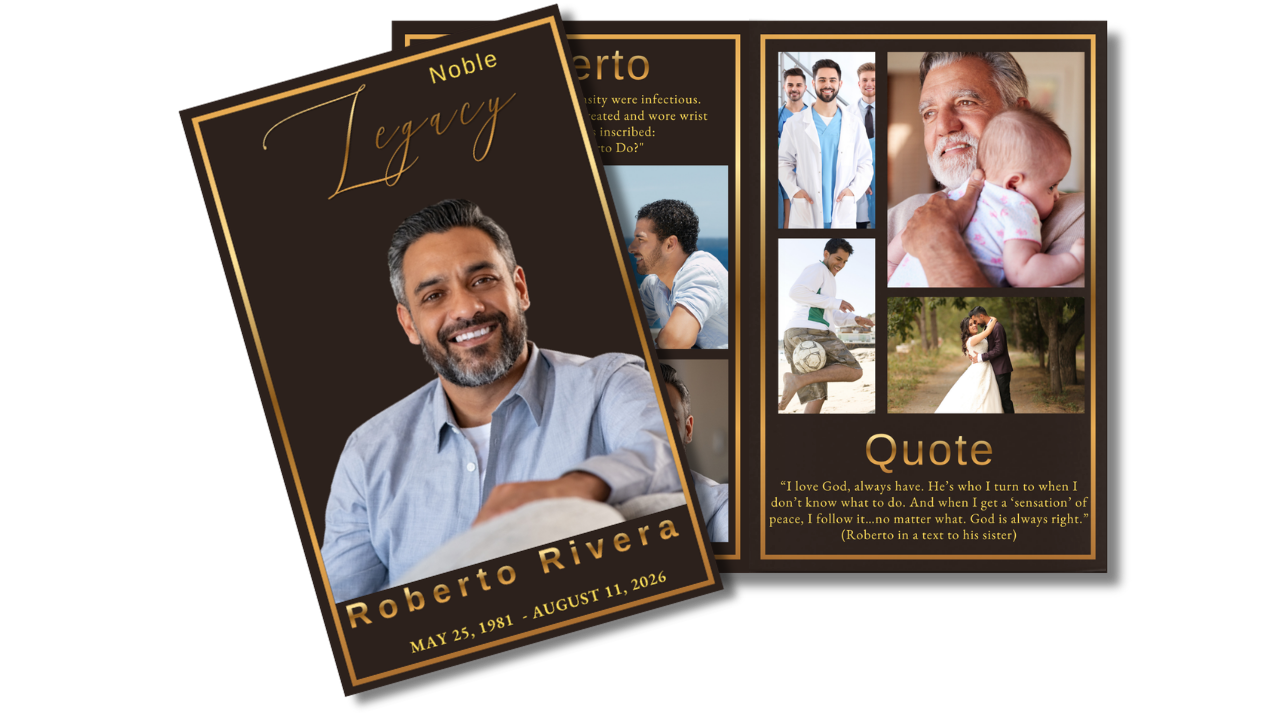
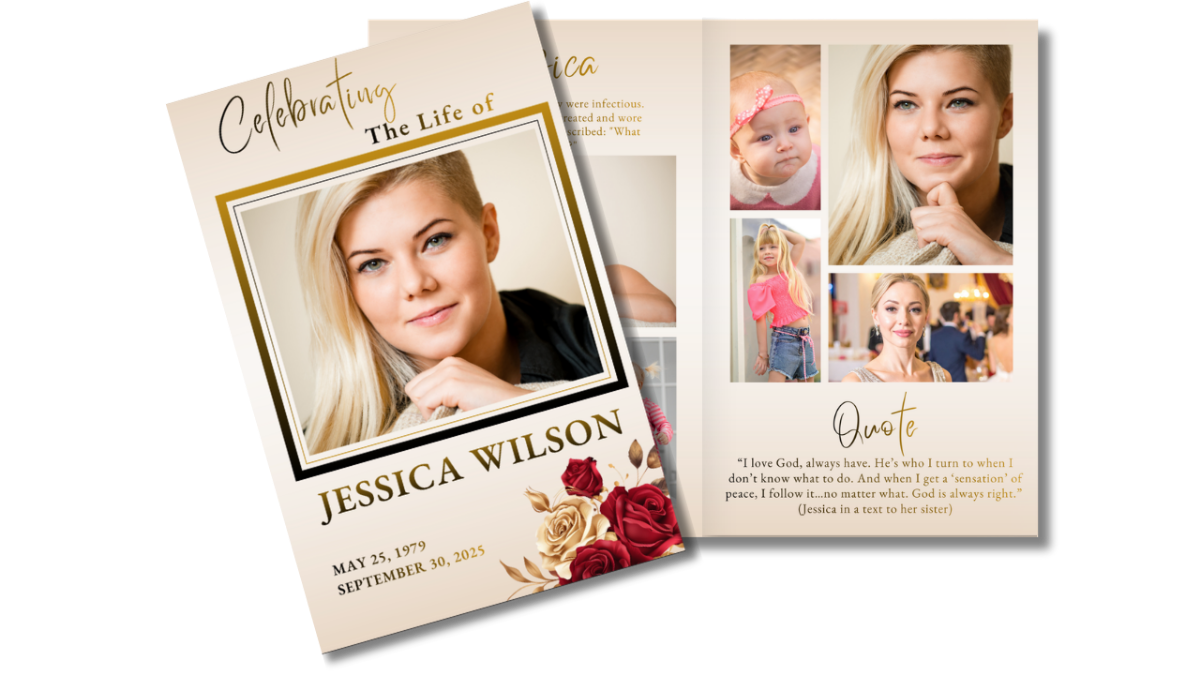
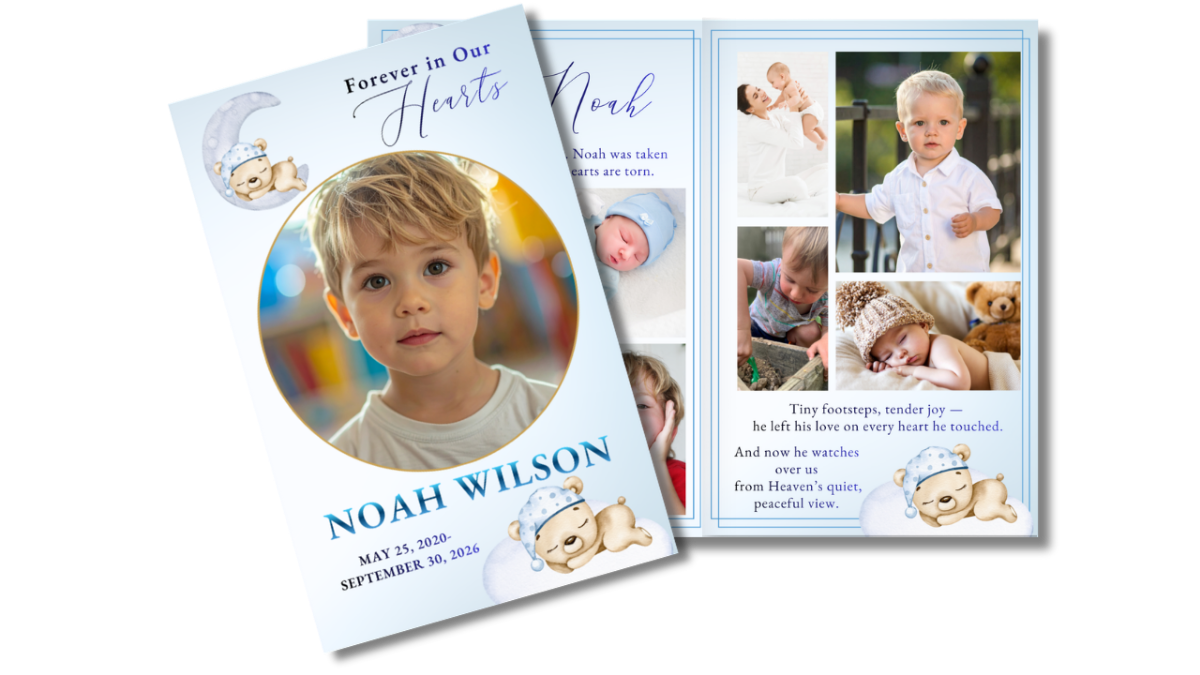
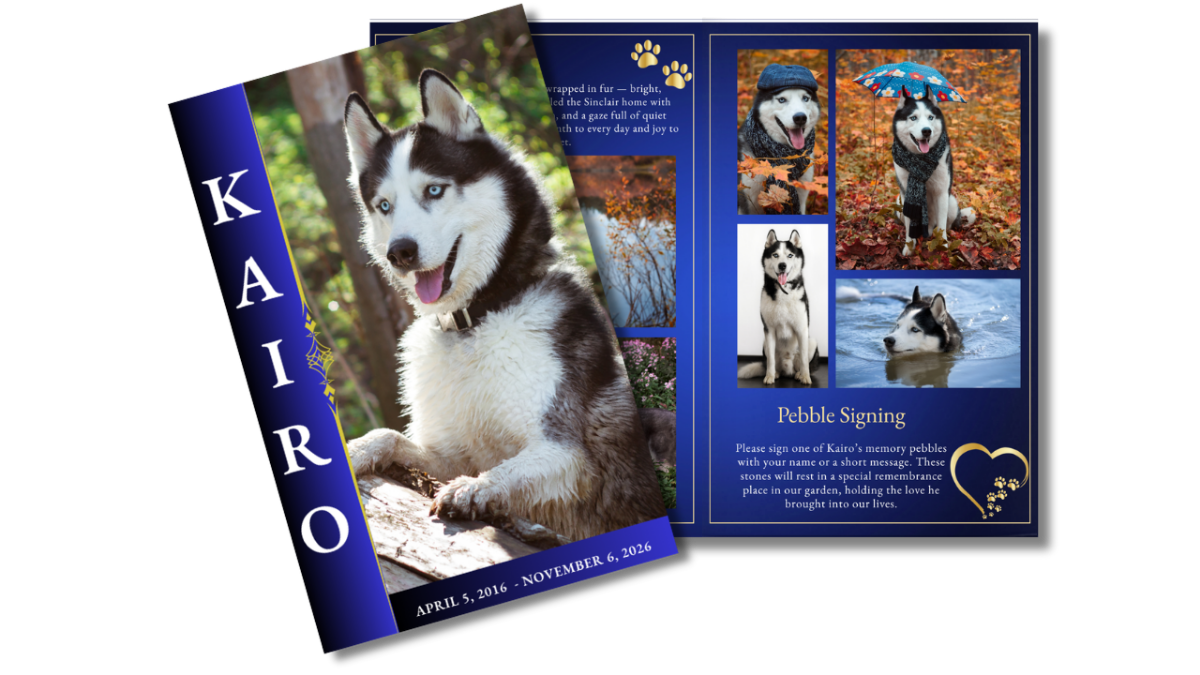
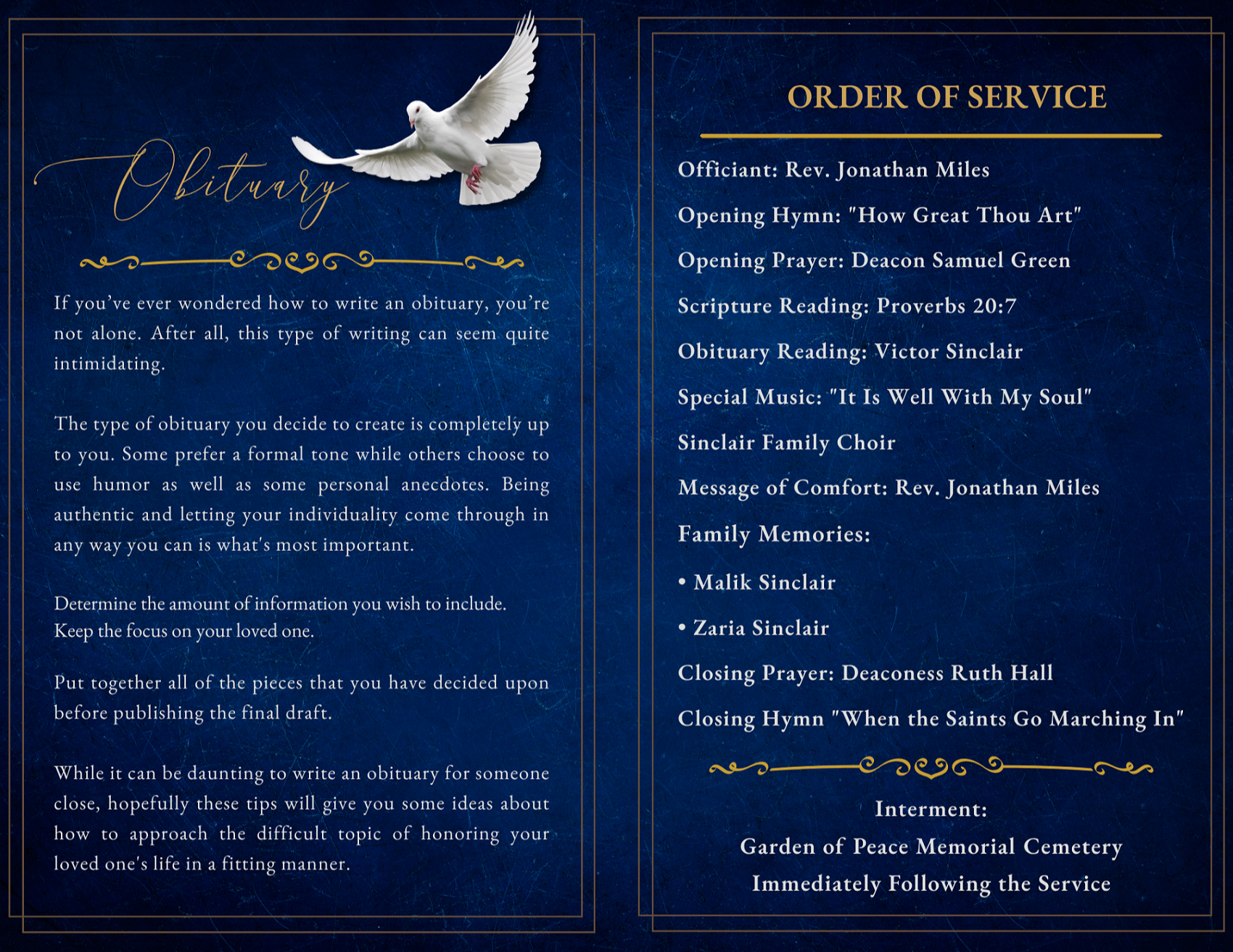
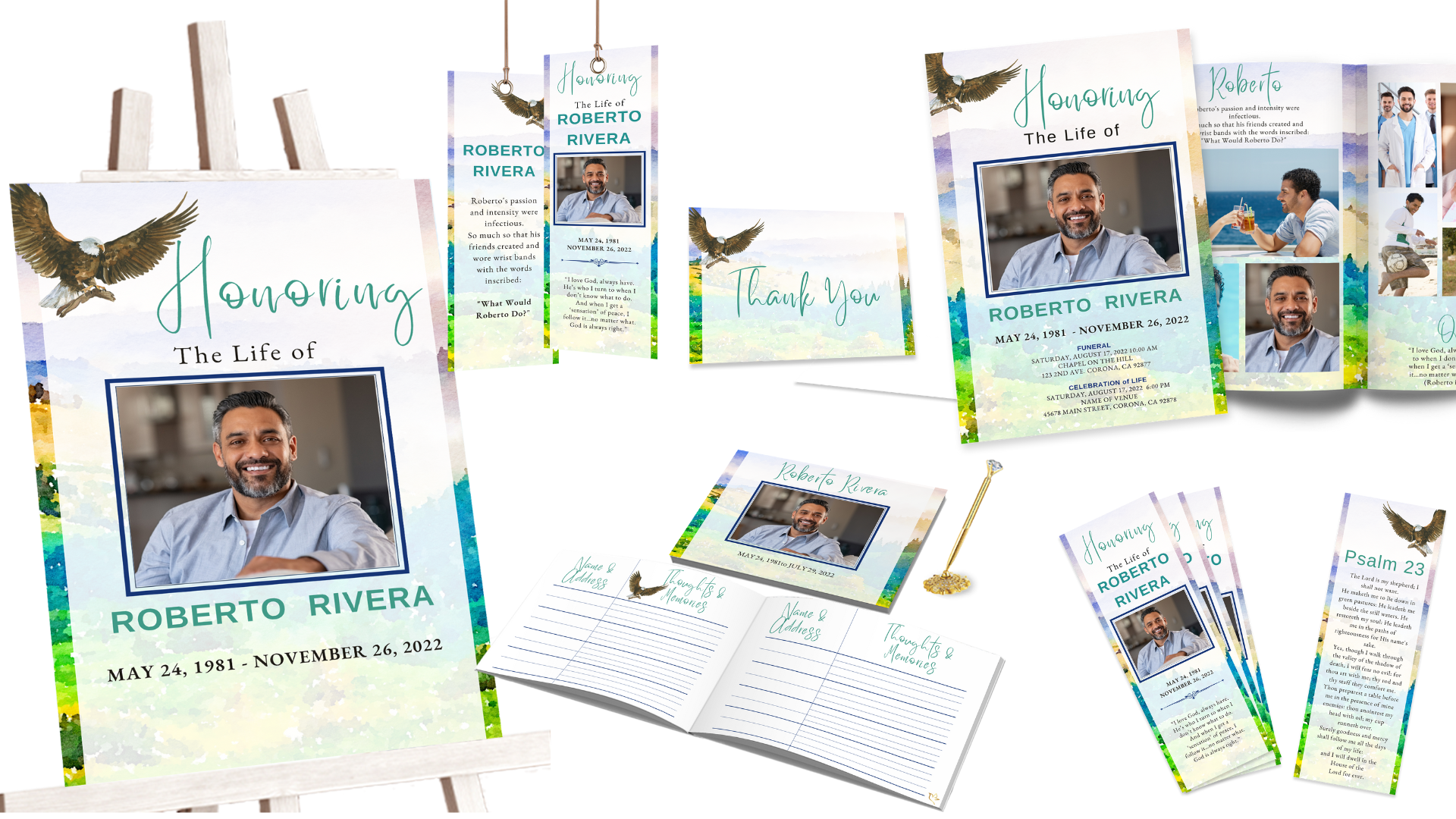
A funeral program can bring together your daughter's photograph, obituary, order of service, readings, poems, and other meaningful details in a keepsake family and friends can hold onto after the service.
Explore our funeral program templates when you're ready to create something that reflects her life and personality.
Obituary Guide
An obituary generally records the important details of your daughter's life and announces her passing, while the eulogy gives you more space for stories, memories, and personality.
Our obituary guide can help you decide what to include and how to organize it.
Funeral Poems
Sometimes someone else's words give voice to feelings that are difficult to express yourself.
A funeral poem can be read during the service, printed in the funeral program, included with a memorial display, or simply kept privately by those who loved her.
Funeral Readings
A meaningful reading may come from scripture, poetry, literature, or another source that reflects your daughter's beliefs, values, personality, or the love surrounding her.
You Don't Have to Fit a Lifetime of Love Into a Few Pages
There is something impossible about trying to reduce your relationship with your daughter to a handful of pages.
So don't try.
Your eulogy does not have to contain every memory.
It doesn't have to mention every accomplishment, every person she loved, or every moment you shared.
There will always be more.
More photographs.
More stories.
More things you suddenly remember six months from now.
More ordinary moments that will come back because of a song, a smell, a place, or something someone says.
That doesn't mean you left something important out.
It means your daughter's life was larger than any speech could hold.
Choose the memories that bring her closest.
Tell people what made her laugh.
Tell them what made you proud.
Tell them about the little girl you remember and, if you were given the time, the woman you had the privilege of watching her become.
Let your words sound like a parent remembering a daughter rather than a writer trying to create a perfect eulogy.
Because perfection is not what makes a tribute beautiful.
Recognition is.
It is the moment someone listening smiles through tears because the story you just told is so completely her.
It is the moment a friend learns something about her childhood they never knew.
It is the moment you realize that even though you cannot tell every story, you have helped keep one more of them alive.
Your daughter was here.
She was loved.
Her life mattered.
And nothing about the length of her life can change the love that remains.

You’re welcome to explore our funeral program collections and find the design that feels right for your loved one—created to help you honor their memory with care and ease.
Each template is fully editable in Canva, allowing you to add photos, update text, adjust colors, and personalize every detail—no design experience needed.
If you need additional support during this tender time, our compassionate team is here for you. Please fill out the form below, and let us guide you through creating a beautiful memorial for your loved one. We're with you every step of the way
Your privacy is incredibly important to us. Rest assured, we will always protect your information and never share it with anyone, for any reason. We're committed to keeping your trust