How to Write a Eulogy for My Brother

A Heartfelt Guide
Losing a brother can feel like losing someone who carried a piece of your history with him.
He may have known you before you knew yourself. He may have been there for childhood adventures, family vacations, school years, scraped knees, terrible haircuts, inside jokes, arguments that seemed enormously important at the time, and stories your family has repeated so often that nobody remembers anymore who originally told them.
Maybe he was your older brother—the one who went first, tested the boundaries, and occasionally convinced you to do something you definitely should not have done.
Maybe he was your younger brother, and some part of you always felt protective of him no matter how old the two of you became.
Perhaps you were close in age and grew up almost as a team. Or perhaps years separated you, and your relationship became closer only after you were adults.
There isn't one kind of brother, and there isn't one kind of sibling relationship. Some brothers become best friends. Some spend half their lives teasing each other and the other half quietly showing up whenever they're needed. Some talk every day. Others can go months without talking and somehow resume the conversation as though no time has passed at all.
And sometimes the relationship is more complicated than any of those descriptions.
You may have loved your brother deeply while also disagreeing with him, worrying about him, becoming frustrated with him, or going through periods when you weren't particularly close. Real sibling relationships contain history, and history is rarely simple.
Now you're being asked to take all of that—the childhood, the adulthood, the laughter, the disagreements, the family stories, and the man your brother became—and turn it into a few minutes of words.
That is a lot to ask of someone who is grieving.
So don't begin by trying to explain his entire life.
Begin with your brother.
The way he laughed. The things he cared about. The stories everybody tells about him. The things only you remember. The ways he changed as he grew older. The person he became beyond your family. The role he played in your life, and the empty place his absence leaves behind.
A beautiful eulogy doesn't have to tell everyone everything about your brother.
It only has to help them remember him.
Why Writing a Eulogy for Your Brother Feels So Difficult
Siblings often know versions of us that no one else ever gets to meet.
Your brother may have known the child you once were. He may remember the house where you grew up, the neighborhood kids, the family rules, the teachers, the pets, the vacations, and the things that happened around your dinner table that would make absolutely no sense to anyone outside your family.
He may have remembered your parents when they were younger.
He may have known why one word or expression could send both of you into uncontrollable laughter.
And perhaps most importantly, you didn't have to explain your family's history to him.
He was there.
That shared history can make the death of a sibling feel especially disorienting. You haven't only lost someone you love. You may have lost one of the people who remembered your life alongside you.
Writing his eulogy can bring all of that rushing forward at once.
You might find yourself remembering things you haven't thought about for decades. One photograph can suddenly take you back to a summer afternoon. A song can put you both back in the car. An old family joke can make you laugh and then cry because you realize he was the person you would have called to tell it to.
At the same time, your brother was much more than the boy who grew up beside you.
He became his own man.
Perhaps he was a husband or partner, a father, grandfather, uncle, friend, coworker, neighbor, coach, mentor, or community member. He developed interests and relationships and built parts of a life that didn't include you at all.
That doesn't diminish your bond.
It makes his story larger.
Your eulogy gives you the opportunity to bring those pieces together—to remember the boy you knew, the man he became, and the brother he remained throughout it all.
Six Simple Steps to Writing a Heartfelt Eulogy for Your Brother
When you're grieving, staring at a blank page and thinking, I have to write my brother's eulogy, can make the task feel enormous.
So don't start there.
You don't need a finished speech yet. You need memories. Once you have those, you can begin deciding which ones tell his story best.
Step 1: Start With the Memories You Share
Before worrying about structure, write down whatever comes to mind when you think about your brother.
Think about childhood, but don't stop there. Remember teenage years, adulthood, holidays, marriages, children, vacations, phone calls, family gatherings, difficult seasons, and ordinary days.
Look through old photographs if you have them. Read old texts or emails. Think about the things you did together and the stories you told about each other.
You may remember something surprisingly small: the way he answered the phone, a nickname he called you, the food he always ordered, the ridiculous thing he did every Christmas, or the expression on his face when he knew he was about to make you laugh.
Write it down.
Those seemingly little memories are often where the real person lives.
Step 2: Ask Yourself What Made Him Your Brother
Try completing this sentence:
“When I think of my brother, I immediately think of…”
Don't try to make the answer profound.
Maybe you think of his laugh.
His stubbornness.
His loyalty.
His truck.
His music.
His terrible jokes.
His love for his children.
His ability to fix almost anything.
The way he could irritate you more quickly than any other human being on earth and somehow still be the person you wanted beside you when something went wrong.
Whatever comes naturally is worth paying attention to.
That may be where the heart of your eulogy begins.
Step 3: Choose Two or Three Stories That Show Who He Was
You don't need to describe your brother with a long list of adjectives.
Show people instead.
If he was generous, tell them about something generous he did.
If he was funny, share a story that lets everyone hear his humor again.
If he was fiercely protective of the people he loved, tell the story that proves it.
One story from childhood and one or two from adulthood can work particularly well because they allow people to see both the brother you grew up with and the man he became.
The goal isn't to choose the most impressive stories.
Choose the ones that feel most like him.
Step 4: Let Him Be More Than Your Brother
This can be especially important when one sibling gives the eulogy.
Your relationship with him was unique, but it wasn't his only relationship.
Think about who else he was.
What kind of friend was he? What kind of husband or partner? What kind of father, uncle, grandfather, coworker, neighbor, or mentor?
What did he care about when he wasn't with your family?
What was he proud of?
What did he spend his time doing?
What did other people rely on him for?
If possible, talk with people from other parts of his life. Ask them for a favorite memory. You may hear stories you've never heard before, and those stories can help you see just how many lives your brother touched.
Step 5: Think About What He Leaves Behind
Legacy doesn't have to mean something enormous.
Sometimes a person's legacy lives in very ordinary places.
Maybe your brother taught his children to love the outdoors.
Perhaps he was the person everyone called when something broke.
Maybe he created a family tradition that will continue without him.
Perhaps he taught you something years ago that you still do today.
His influence may live in his children, in the people he helped, in the work he did, in the friendships he built, or simply in the stories people will continue telling about him.
Ask yourself:
What is different in this world because my brother was here?
The answer may give you one of the most meaningful parts of your eulogy.
Step 6: Write Like His Brother or Sister, Not Like a Professional Speaker
You don't need funeral language.
You don't need to sound formal.
You don't need to write something that sounds as though it belongs in a book.
You need to sound like you talking about him.
If everyone called him by a nickname, use it.
If he had a phrase everyone associates with him, include it.
If he did something that drove you crazy for thirty years and now you'd give anything to have him do it one more time, you can say that.
And if there are things you simply cannot put into words yet, you don't have to force them.
A eulogy isn't a performance.
It is one person standing in front of other people who loved someone and saying, in whatever words they can manage:
This was my brother. This is what he meant to us. This is why we will remember him.
Questions to Help You Remember Your Brother
Grief can do strange things to memory. You may have spent decades with your brother and then sit down to write about him and suddenly feel as though you can't remember anything at all.
Don't panic.
Instead of demanding stories from yourself, begin asking questions. Let your mind wander through different stages of his life and your relationship.
These questions may help:
- What is my earliest memory of my brother?
- What did we do together when we were children?
- What did we argue about when we were young?
- What family story involving him still makes everyone laugh?
- What was something he was especially good at?
- What could he talk about for hours?
- What was he passionate about?
- What did he do that could always make me laugh?
- What did he do that could always make me roll my eyes?
- What did he teach me?
- When did he show up for me when I really needed him?
- What did I admire about the man he became?
- How were we alike?
- How were we completely different?
- What role did he naturally play in our family?
- What did his friends love about him?
- What was he proudest of?
- What ordinary thing about him do I already miss?
- What part of him do I see living on in his children, family, or friends?
- If I could spend one more ordinary day with him, what would we do?
- If I could tell him one more thing, what would I say?
You don't need to answer every question.
You may find that one of them opens a door.
Suddenly you're remembering the road trip when everything went wrong, the Christmas he gave you that ridiculous gift, the afternoon he helped you move, the conversation you had when you were going through something difficult, or the time the two of you laughed until neither of you could breathe.
Follow those memories.
They are often far more valuable than trying to construct the “perfect” tribute.
Common Mistakes to Avoid
One common mistake when writing a eulogy for a brother is spending so much time on childhood that the adult man almost disappears.
Childhood stories are important because siblings share a history no one else does. But your brother kept becoming himself long after the two of you left home. Give the people listening a chance to see the whole person—the boy you remember and the man others came to know and love.
Another mistake is trying to include every story.
You can't fit a lifetime into a eulogy, and you don't need to. Two or three meaningful stories will usually stay with people much longer than fifteen stories told quickly.
It's also easy to fall into generic descriptions: He was kind. He was funny. He loved his family.
Those things may all be true, but go one step further.
What did his kindness look like?
Who did he help?
What did he do when someone needed him?
What kind of funny was he?
How did he show his family that he loved them?
Specific details transform a description into a person.
You also don't need to pretend your relationship was perfect.
Brothers and sisters argue. They annoy each other. They go through difficult periods. Sometimes they grow apart and find their way back to each other. Sometimes there are things left unresolved.
A eulogy doesn't require you to rewrite your history.
You can choose kindness without pretending.
You can honor the good without claiming there was never anything difficult.
And finally, don't judge the eulogy by how successfully you manage not to cry.
Your brother died.
You are allowed to grieve him.
If your voice shakes, let it shake. If you need to stop and breathe, stop. If you laugh halfway through a story and then immediately cry, that may be one of the most honest moments in the entire tribute.
The people listening aren't waiting for a flawless speech.
They want to remember your brother.
And if, while you're speaking, they can see him again for a moment—the way he laughed, the things he did, the person he was—then your words have done exactly what they needed to do.
Sample Opening for a Eulogy for Your Brother
The first few sentences can be difficult because a brother may have been part of your story for so long that you hardly know where his story ends and yours begins.
You do not need to start with his whole life. You can begin with the bond.
Perhaps you remember the boy who grew up beside you, the person who teased you mercilessly, the one who knew the family history without explanation, or the man who became someone you admired in ways you did not fully understand when you were younger.
Sample Opening
“When I try to think about how to describe my brother, I keep coming back to one thought: he knew a version of me that almost no one else did.
He knew the childhood stories.
He knew the family jokes.
He knew exactly which memories could make me laugh and which ones I never needed explained.
We grew up together, sometimes side by side and sometimes completely at odds, but through all of it, he was part of the landscape of my life.
Today, I want to tell you a little about the boy I grew up with, the man he became, and the brother I will always miss.”
A simpler opening can work just as well. You might say, “I don't think there is any way to sum up a lifetime between siblings, so instead I want to share a few stories that feel like my brother.”
Sample Closing for a Eulogy for Your Brother
The end of the eulogy does not need to tidy up everything you feel.
Sibling relationships are often full of history, humor, frustration, loyalty, and love, and there may be no single sentence that captures it all.
You can end with gratitude.
You can end with a story.
Or you can simply speak directly to your brother.
Sample Closing
“Mark, I still cannot quite imagine this family without you in it.
There are stories I will keep telling because they are too good not to tell. There are things you said that I already hear myself repeating. There are moments I would give anything to relive, even the ones I did not appreciate enough when they were happening.
Thank you for being my brother.
Thank you for the laughter, the arguments, the memories, the loyalty, and the years of shared history that no one else could ever replace.
I love you.
I miss you.
And no matter how much time passes, you will always be part of my story.”
Complete Sample Eulogy for a Brother
The example below is not meant to be copied word for word. Your brother had his own personality, his own relationships, and his own way of being in the world.
Use this sample only as a guide for how childhood memories, adult life, humor, family bonds, and grief can come together naturally.
Sample Eulogy
When I sat down to write about my brother, I thought I should begin with the important things.
The dates.
The jobs.
The milestones.
The things people usually include when they talk about someone's life.
But that did not feel like him.
What felt like him was the sound of his laugh.
The way he could tell a story and make it ten times funnier than it probably was.
The way he could annoy me faster than anyone else on earth and somehow still be the person I wanted to call when something went wrong.
That was my brother.
We grew up together, which means we shared a lot of things whether we wanted to or not.
Family vacations.
Bedrooms at various points.
Arguments over things that made perfect sense at the time and absolutely none now.
Inside jokes.
Embarrassing stories.
Things we knew about each other that no one else ever would.
When we were kids, I don't think I understood how unusual it was to have someone beside me who was seeing the same family from almost the same angle.
He knew the house we grew up in.
He knew our parents when they were younger.
He knew the relatives, the routines, the stories, the rules, and the things that only made sense because we had both lived them.
As we got older, our relationship changed.
We stopped being just two kids in the same family.
We became adults with our own lives.
He became someone other people depended on.
A friend.
A coworker.
An uncle.
A husband and father, if you were lucky enough to know him in those roles.
And one of the things I came to appreciate more as I got older was that my brother was not the same person to everyone.
To me, he was always going to be the kid who once [insert family story or childhood memory].
But to his friends, he was the person who showed up when they needed help.
To his family, he was someone who cared deeply, even if he did not always say it in perfect words.
To the people he worked with, he was the one they could count on.
And to all of us, he was unmistakably himself.
He had opinions.
A lot of them.
If he thought he was right about something, he was willing to explain why for as long as necessary.
And sometimes longer.
He had habits we teased him about.
Stories he told repeatedly.
A way of doing certain things that made the rest of us shake our heads.
But those are exactly the things I miss now.
The quirks.
The annoyances.
The familiar things that once felt ordinary.
Because grief has a way of turning ordinary things into treasures.
I think about the phone calls.
The holidays.
The way he walked into a room.
The look on his face when he knew he was about to say something he thought was funny.
I think about conversations I did not know I should memorize.
I think about all the years when I assumed there would always be another family gathering, another story, another chance to argue about something ridiculous.
And now I understand how precious those ordinary moments were.
My brother was not perfect.
Neither am I.
We had disagreements.
We frustrated each other.
There were times we probably both thought the other one was impossible.
But underneath all of that was something steady.
History.
Loyalty.
Family.
Love.
And that is what I keep coming back to now.
He was part of my life for so long that I do not know how to imagine my story without him in it.
But I also know that he does not disappear simply because he is gone.
He is in the stories we keep telling.
He is in the phrases we repeat.
He is in the people he loved and the ways he shaped them.
He is in the memories no one else shares quite the way I do.
And he is in me.
Brother, thank you for growing up beside me.
Thank you for making me laugh.
Thank you for showing up.
Thank you for being part of every chapter, even when we did not always know how much those chapters would one day mean.
I love you.
I miss you.
And I will carry our story with me for the rest of my life.
A Simple Eulogy Outline for Your Brother
If you still have a collection of memories but are unsure how to organize them, this outline can help.
You do not need to use every section. Let the structure serve the story rather than forcing your brother's life into a formula.
1. Begin With the Bond
Start with what it meant to be his brother or sister. You might mention your shared childhood, the years between you, or the role he naturally played in the family.
2. Remember the Boy He Was
Choose one or two childhood memories that reveal his personality. These do not need to be dramatic. A funny, ordinary story can be far more memorable.
3. Talk About the Man He Became
Move into adulthood. What mattered to him? What kind of friend, husband, father, uncle, coworker, or neighbor did he become?
4. Share Two or Three Stories
Choose stories that show his humor, loyalty, kindness, stubbornness, generosity, or whatever made him most himself.
5. Describe Your Relationship Honestly
You can acknowledge that sibling relationships are not always perfect. Focus on the bond, the history, and the things only the two of you shared.
6. Talk About What He Leaves Behind
What do you see continuing because he was here? Think about family traditions, values, stories, relationships, or traits other people carry forward.
7. Say What You Will Miss
Often the most meaningful details are ordinary: his voice, his jokes, his calls, his presence at family gatherings.
8. Say Goodbye
You can end simply with gratitude and love.
“Thank you for being my brother” may say everything you need it to say.
Frequently Asked Questions About Writing a Eulogy for Your Brother
How long should a eulogy for my brother be?
Most eulogies last about five to ten minutes, but there is no perfect length.
Do not try to prove the importance of the relationship by speaking longer. A few meaningful stories can carry far more emotion than a long list of facts.
Should I talk about childhood?
Yes, especially because childhood memories are one of the things siblings uniquely share.
But if your brother lived into adulthood, let the eulogy grow with him. Include something about the man he became as well as the boy you remember.
What if we had a complicated relationship?
You can still write an honest and respectful eulogy.
You do not need to pretend the relationship was perfect, and you do not need to discuss private conflicts publicly.
Focus on what was real, what mattered, and what you are grateful for. A meaningful tribute can contain love without rewriting history.
Can I include funny stories?
Absolutely.
Sibling relationships are often built on humor, teasing, shared disasters, and stories no one else fully understands.
If a story makes people smile and feels respectful, it may be exactly what helps everyone recognize your brother in your words.
What if I cry while reading?
That is completely okay.
Pause when you need to. Keep a printed copy in a large font and ask someone you trust to be ready to continue if you become overwhelmed.
You are not giving a performance.
You are grieving your brother.
What if another sibling is also speaking?
That can be beautiful.
You may each remember different versions of him. One sibling might focus more on childhood while another shares stories from adulthood.
There is no need for the eulogies to match. Together, they can show a fuller picture of who he was.
Related Resources for Honoring Your Brother
Writing the eulogy may be only one part of preparing for your brother's funeral or memorial service. You may also be helping with the obituary, selecting photographs, choosing readings, or creating a funeral program.
Take each piece one at a time.
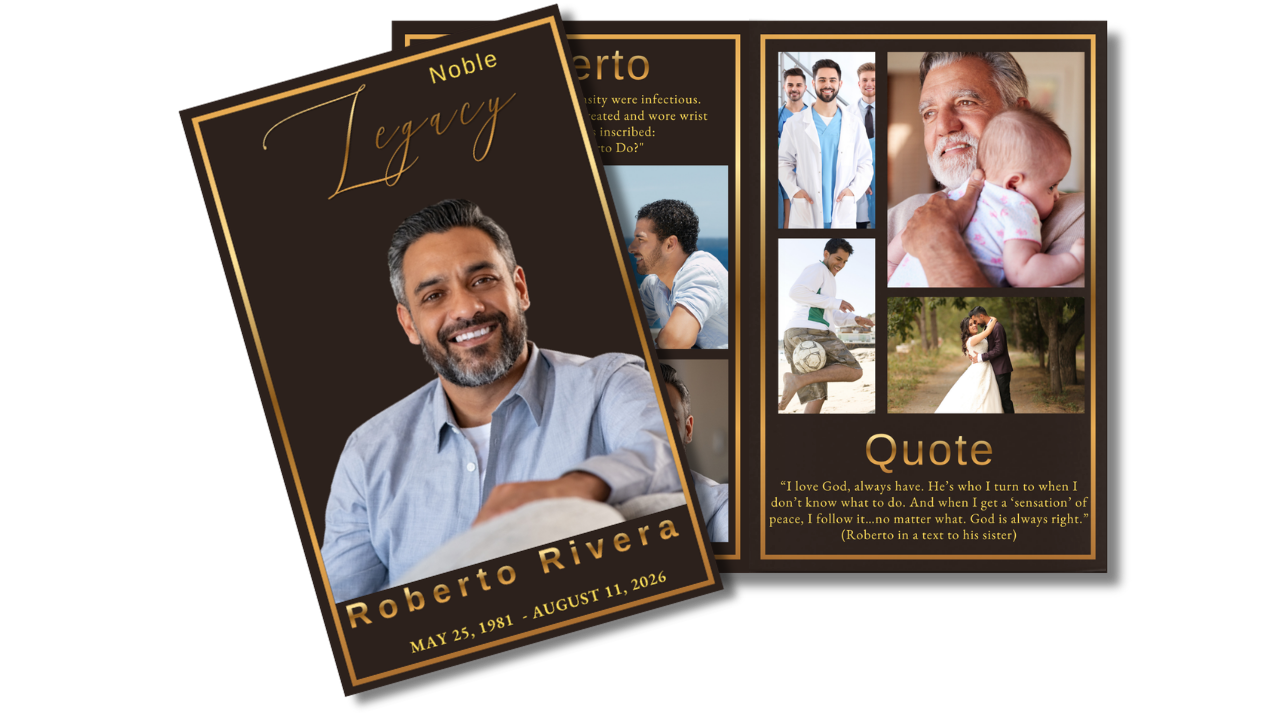
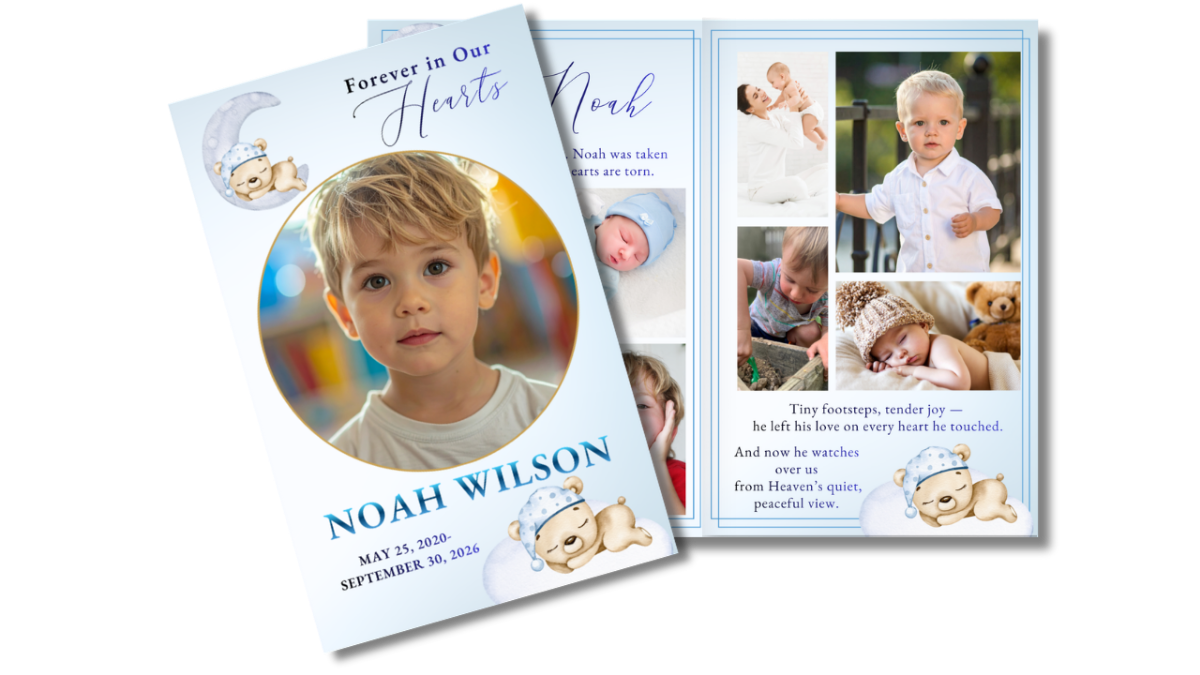
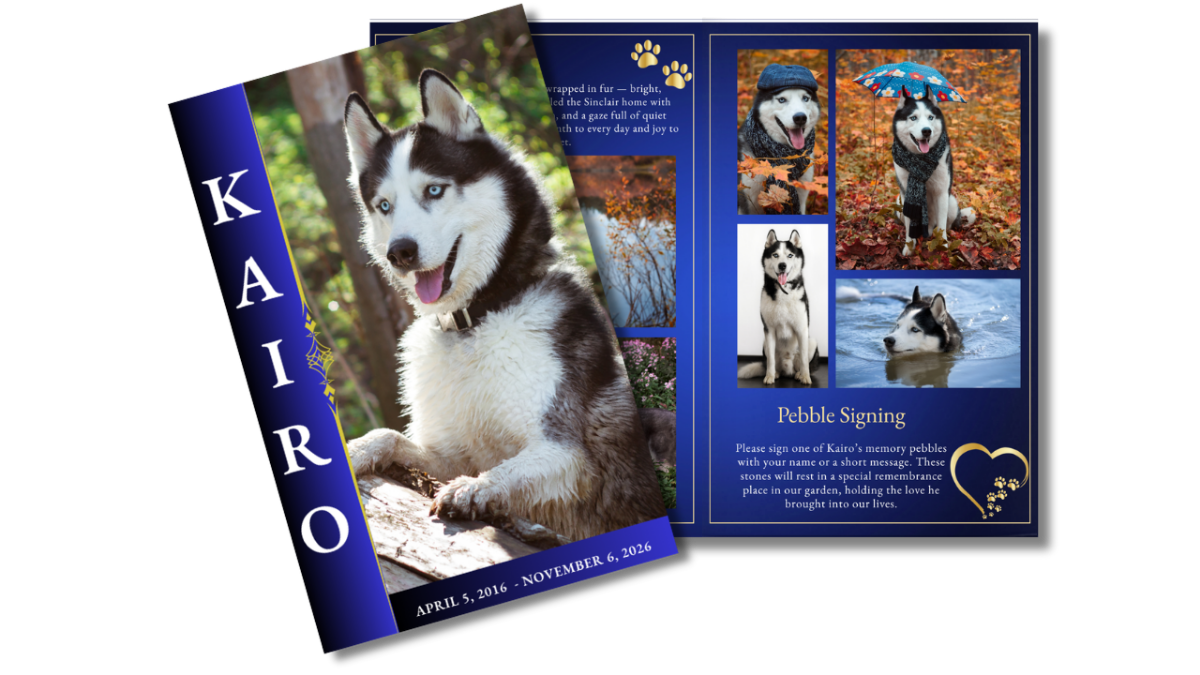
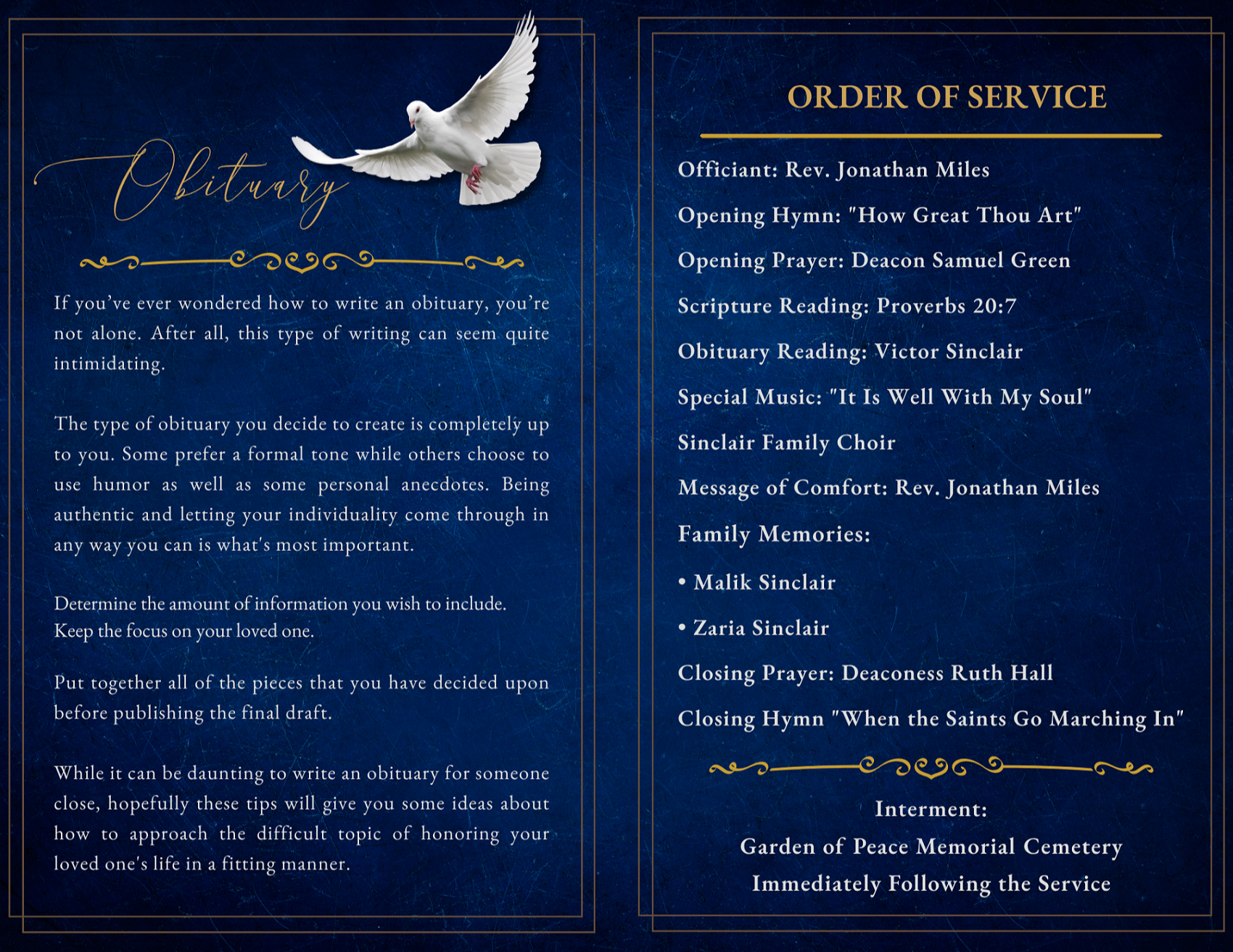
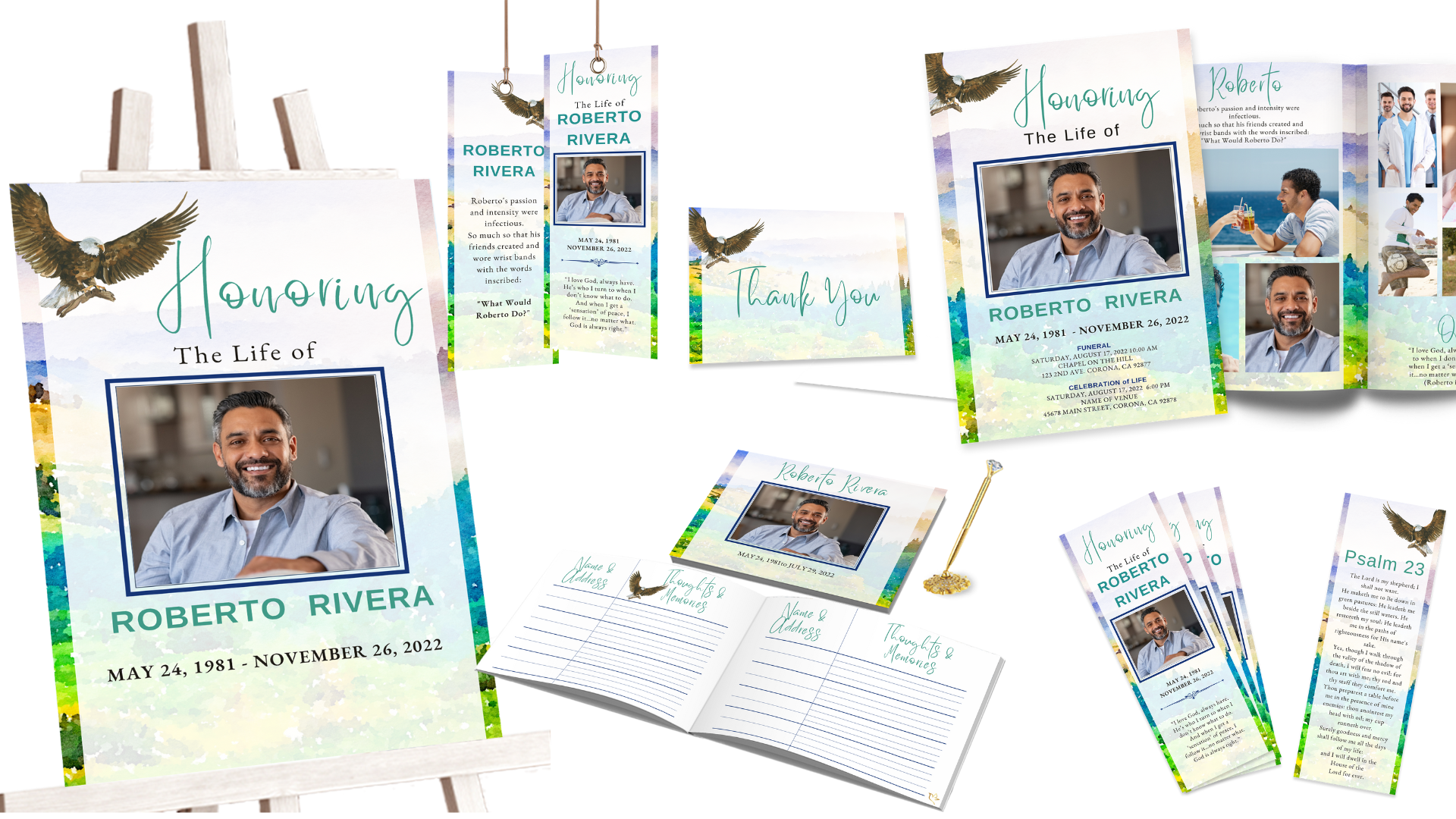
Funeral Programs
A personalized funeral program can bring together your brother's photograph, obituary, service details, readings, poems, and other meaningful memories in a keepsake for family and friends.
Obituary Guide
The obituary records the important facts and relationships of his life, while the eulogy gives you more room for stories, personality, and memories.
Our obituary guide can help you organize those details when you are ready.
Funeral Poems
A meaningful poem can sometimes express something that is difficult to say in your own words. It can be included in the service, printed in the program, or shared privately with family.
Funeral Readings
Readings from scripture, literature, poetry, or other meaningful sources can help reflect your brother's beliefs, personality, or values.
Some Bonds Never Stop Being Part of You
There are people in our lives whose stories become tangled up with our own.
A brother can be one of them.
You may have shared a home, a childhood, parents, holidays, family traditions, secrets, arguments, laughter, and years of memories no one else could ever experience in quite the same way.
When he is gone, you do not only miss the person.
You miss the shared history.
The person who knew why that story was funny.
The person who remembered the same house.
The person who could bring back an entire chapter of your life with a single sentence.
You cannot put all of that into one eulogy.
You do not have to.
Choose the stories that feel most like him.
Let people remember his personality.
Let them laugh if something is funny.
Let yourself be honest about the bond you shared.
And when you reach the end, remember that the relationship does not vanish because his life ended.
Your brother remains in the stories.
In the family.
In the memories.
In the things he taught you.
And in the part of your own story that will always include him.
That is why a eulogy does not need to be perfect.
It only needs to help everyone in the room think:
Yes. That was him.

You’re welcome to explore our funeral program collections and find the design that feels right for your loved one—created to help you honor their memory with care and ease.
Each template is fully editable in Canva, allowing you to add photos, update text, adjust colors, and personalize every detail—no design experience needed.
If you need additional support during this tender time, our compassionate team is here for you. Please fill out the form below, and let us guide you through creating a beautiful memorial for your loved one. We're with you every step of the way
Your privacy is incredibly important to us. Rest assured, we will always protect your information and never share it with anyone, for any reason. We're committed to keeping your trust